2 min read
Archive Dive: Givenchy’s Country
Welcome to Archive Dive—my new excuse to obsess over the absolute treasures hiding in House Beautiful’s 130-year-old archives. Every month, we’ll dig up a favorite story from the past (epic room makeovers, wildly bold design swings, and style moments that were way ahead of their time) and talk about why they still resonate today. It’s part history lesson, part design deep-dive, and 100 percent a love letter to the iconic taste that’s defined HB for over a century.
—Jo Saltz, House Beautiful Editor in Chief

Perched on the banks of the Aigre River and surrounded by a moat, the sprawling 16th-century Château du Jonchet was acquired—and, of course, redecorated—by couturier Hubert de Givenchy in the 1970s as a getaway from his primary residence in Paris. House Beautiful editor Caroline Englefield spoke with the designer about his day-to-day life, decorating style, and tips for hosting guests in the country for a package about personal style in our July 1988 issue.

By Caroline Englefield
Hubert de Givenchy's country house provides what we all crave—a simple life. "Some weekends I never even go into the village," he tells you. "I stay here at Le Jonchet sketching, sitting by the fire, or walking in the garden with the dogs." Le Jonchet is the 16th-century manor house where M. de Givenchy has spent weekends and holidays for the past 12 years. Of course, not everyone would consider life in a moated manor with four towers simple.


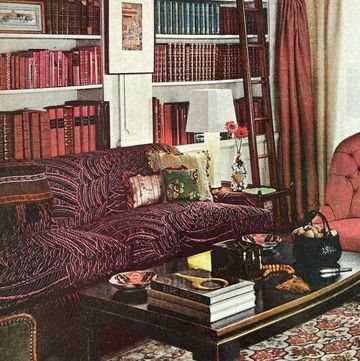
However, for M. de Givenchy, whose very formal Paris flat is filled with rare 17th- and 18th-century antiques, this is a place to unwind. In the spirit of someone used to setting style rather than following it, the master of haute couture has borrowed from the past where it suits him and created contemporary settings elsewhere. For instance, he decorated the bedrooms for intimacy in a traditional manner, by lavishing bolts of fresh cotton on walls, chairs, and beds. "But one doesn't need the same intimacy in a salon," says M. de Givenchy, who finds the absence of pattern and color there soothing. “I know when friends come to visit, they will be comfortable," says M. de Givenchy.
— M. DE GIVENCHY (On his lavish use of one pattern)

The comfort of the guest rooms derives in large part from a family custom of using one fabric for everything: chairs, bed hangings, curtains. "My mother and my aunt always decorated their bedrooms this way, and because I was happy in those rooms, I repeat the custom here." M. de Givenchy pays close attention to details throughout the house. For instance, in the salon, he puts out new books on the Giacometti table every week. "In the country, it is very important to have plenty of books, pillows, and blankets," he says. Ah, to be a guest at chez Givenchy!