4 min read
Here at House Beautiful, we didn’t launch our popular (and still-running) Next Wave awards until November 1998, as a way of spotlighting emerging talents in the field of interior design. Even before that, though, the magazines’ pages were packed with features about the homes of great designers. Often based in New York City, with weekend houses in the surrounding farmland of Connecticut and Long Island, these homes show how some of the very best designers of modern times lived stylishly, right when they were getting started or establishing clientèle. Read on to see how ten of them settled in alongside thrifted antiques, bold fabrics and wallcoverings, and early iterations of their own designs.
Peter Pennoyer & Katie Ridder
New York City (1991)


A story in our October 1991 issue featured the Upper West Side apartment of House Beautiful’s then-contributing editor Katie Ridder and her architect husband, Peter Pennoyer. (The couple met, per the story, when Ridder was reporting on one of Pennoyer’s projects.) Self-proclaimed classicists, Pennoyer and Ridder built the apartment around storied antiques, and did so with creative personality—writer Janet Siroto said that “Both are unable to return from even the grungiest of basement thrift shops without a treasure-in-the-making.”
Thomas Jayne
New York City (1992)


After a stint at Parish-Hadley, the young designer Thomas Jayne was hard at work decorating the governor’s mansion in Richmond, Virginia, when House Beautiful featured his Greenwich Village apartment in their April 1991 issue. Religious prints, reflecting his Episcopalian upbringing, cover the walls. Removing the old carpeting, he discovered the original 1929 cork flooring and buffed it to a “mellow, leatherlike shine,” wrote editor Dana Caponigro.
Manuel Canovas
Paris (1992)


A two-story apartment in Paris, flooded with sunlight and opening to the Champ de Mars gardens near the Eiffel Tower, was the residence of textile designer Manuel Canovas and his family, featured in House Beautiful’s June 1992 issue. On a background of the yellows, soft reds, and blues of 18th-century France, he splashed oversized patterns—his controversial signature style. “We love to sit here,” he told HB. “I think it proves you should do what you like and not what’s expected.”
Albert Hadley
Connecticut (1992)


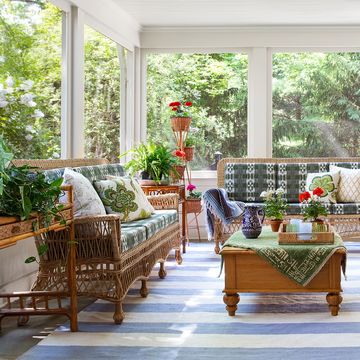
While very much entrenched in New York City life as a partner at Parish-Hadley, Albert Hadley found his getaway en route to a library book sale in Connecticut. There, a 19th-century Italianate Victorian house with clematis vines climbing the porch called his name. Moving right in with his collection of family heirlooms, comfortable chairs, shiny objects, and (inanimate decorative) animals, the house exuded a comfortable elegance right away and was featured in our October 1992 issue.
Bunny Williams
Connecticut (1994)


“Weekend guests never want to leave the rambling old house in rural Connecticut where New York decorator Bunny Williams cultivates eternal summer,” wrote Christine Pittel in the July 1994 issue of House Beautiful. It’s a home the designer still owns and cherishes, but one that has surely evolved in the 30 years since the story debuted. Back then, it was defined by her preferred “in-between colors:” a papery peachy-pink in the living room, a glazed blue-green in the library, plus umpteen old treasures and spoils from her favorite sport—antiquing.


Albert Hadley
New York City (1996)


Apart from his rural retreat featured a few years prior, Hadley also kept a modest three-room apartment on NYC’s Upper East Side, where he lived for twenty years. Bolstered by an extensive renovation—wherein, for example, one doorway was moved five inches to line up with another— and regular redecorating, this landing pad was exhibited in our November 1996 issue, all tailored classicism with hits of Hadley’s favorite “four-alarm red.”
Thomas O’Brien
New York City (1998)


“In his own heavenly high-rise apartment,” wrote Carol Prisant in our November 1998 issue, “New York designer Thomas O'Brien practices just what he preaches: a kind of modern, millennial faith in aesthetic restraint and redemptive rehabilitation.” The living room’s soaring 18-foot ceilings reminded the designer of a chapel, and he covered the walls in a creamy white paint that skewed gray in the rain and glowed at night.
Victoria Hagan
Long Island, NY (1999)


Styled after the classic shingled farmhouses of the region, the Hamptons home of designer Victoria Hagan and her husband, publisher Michael Berman, was built new in 1997 by the architect Darren Helgeson and promptly furnished, photographed, and featured in the June 1999 issue of House Beautiful. Eight shades of white paint give it Hagan’s characteristically polished glow, while the furnishings are a true mix. "There are no rules that govern what I put in a room. I rely totally on instinct," Hagan told House Beautiful.
John Rosselli
New Jersey (1999)


As co-owner of Treillage, the storied garden shop, John Rosselli traveled the world in search of antiques (with his future wife and the shop’s co-owner, Bunny Williams). These were then marketed to his own clients or brought back to the trio of farm buildings Rosselli inherited from his family. “After a decade in the small-scale rooms of the 1880s Italianate brick house where he grew up, he began remodeling the poultry barn for guests and soon realized that he preferred the high-ceilinged new spaces for his characteristically large-scale furniture,” wrote Elizabeth H. Hunter in the September 1999 issue of House Beautiful. “So Rosselli put his guests in the brick building, and the henhouse became his own resplendent three-room retreat.”