3 min read
You certainly wouldn’t display a spatula in the living room, and a microwave’s rightful spot is somewhere near the stove. But what about placing kitchen cabinets beyond your cooking space? Increasingly, designers are using this “kitchen only” detail in unconventional ways throughout the home as an unexpected way to infuse architectural texture.
“Kitchen cabinets are such a powerful architectural opportunity because they occupy so much visual real estate in a room,” says interior designer Lindsay Lucas. “The door profile, inset detail, paneling, scale, hardware, appliance integration, and even the way cabinetry meets the ceiling, floor, or adjacent walls can completely change how architectural a space feels.”
Putting kitchen cabinets anywhere except the kitchen may sound unusual, but it works surprisingly well. Ahead, designers share their best tips and ideas for this architecture-infusing trick.
Tips for Using Cabinetry Beyond the Kitchen

Integrating kitchen cabinets into the rest of your home requires some nuance. To keep cabinetry from looking out of place, the key is to treat it more like interior architecture or furniture.
“That can mean using inset construction, more refined door profiles, integrated end panels, furniture-style feet, arched openings, concealed storage, or hardware that feels appropriate to the room,” Lucas says. “I also like to be very mindful of proportion. If something is being used in a living room, hallway, mudroom, or dining area, it should not feel like it was pulled directly from a kitchen layout.”
Interior designer Rainey Richardson also suggests swapping out the front plates for something more architecturally interesting. “A lot of people make the mistake of using the same cabinet face in multiple rooms: dining room, kitchen, mudroom,” she says. “Because the spaces open up to each other, they think the cabinets need to match, but the opposite is true.”
Another simple way to re-outfit cabinetry is with new hardware. Play with scale by using greatly oversized hardware or decidedly small hardware. Metal, stone, wood, acrylic, and glass present a seemingly endless possibility of options and combinations.
7 Unexpected Ways to Use Kitchen Cabinets in Your Home
From the entryway to the bathroom, get inspired by these unconventional uses for kitchen cabinets.
Formal Sitting Room

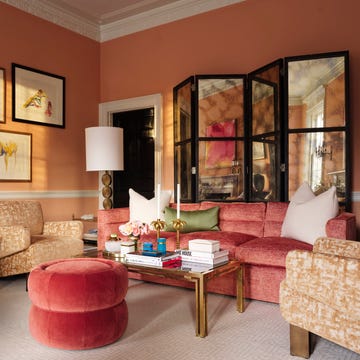
In this formal sitting room designed by Richardson, kitchen cabinets completely transform the space. For more architectural interest, her team mixed plain front cabinets with fretwork and glass doors.
Entry Chest

In this arched wallpapered niche near the entryway, cabinetry creates an architectural moment out of what could have been a simple wall.
“The arched shape, paneled drawer fronts, brass hardware, and mirror all work together so the cabinetry feels integrated into the room rather than added as a storage piece,” Lucas tells us.
Mudroom

Kitchen cabinetry works brilliantly in a true mudroom, as well. Here, interior designer Kelsey Kline Haywood of Kline Interiors bookended a bench with tall cabinetry. Plus, the geometric detail gives them more edge.
She says, “A brass grille insert adds texture to the door and is a way to conceal without using a full cabinet panel.” She also loves this look in a library.
Banquette Dining

In the above space, also designed by Lucas, cabinetry extends beyond the working kitchen and becomes part of the dining experience.
“The island wraps into a built-in banquette with paneled and reeded detailing, so the seating feels connected to the kitchen architecture rather than treated as loose furniture,” Lucas says. It also adds function through concealed storage.
Billiard Room

This family’s billiard room opens to several main rooms in the house, so Richardson decided to borrow the kitchen cabinet style. To make it feel less “kitchen cabinet” and more architectural anchor, she added different trimwork, hardware, and paint color.
Bathroom

Don’t write off upper cabinetry in the bathroom. In this project by Kline Interiors, handsome wood cabinets are paired with reeded glass cabinet paneling. A handle instantly transforms them into a functional piece that feels like it belongs.
Haywood says, “A fluted door profile on a media cabinet or bar gives a strong architectural line that feels like a floating furniture piece, not cabinetry.”
Bay Window Seating

This window seat is a good example of cabinetry becoming a softer, more livable architectural feature. It’s also a smart use of space.
Lucas says, “It adds storage, seating with a custom cushion, and charm while making the window area feel designed rather than leftover.”