4 min read

If you ask Laura W. Jenkins, history has never felt confined to textbooks. To her, it lives in storied architecture, time-worn materials, and the way some homes carry traces of the people who came before. Dive into her own personal history, and you’ll find an engaged but conflicted college student who started out thinking she wanted to pursue historical studies, only to be redirected by a creative spark that even academia couldn’t dim.
“A light bulb went off for me,” she says of discovering interior design and architecture while studying history in college. “It seemed so obvious to me that history informs design.” That realization ultimately reshaped the outline of her next few years; instead of finishing up her degree, she transferred schools, pivoted her major to interior design, and tacked on an art history minor, just to round things out.


While working full-time through school, Jenkins landed an internship during her final semester that became her first job in the industry. She went on to spend years moving through nearly every sector of commercial design—retail, corporate, hospitality—steadily building the technical expertise that now underpins her work. But it wasn’t until she witnessed her husband working for McALPINE that she considered just how rewarding residential design could be. “I loved the idea of building a narrative of home for my clients, and the freedom it would allow me to work with artists, artisans, and craft people on a more consistent basis,” she explains. “I realized that I had something to say under my own name.”
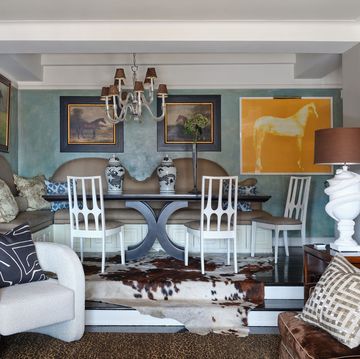
These days, it’s Jenkins deep well of historical knowledge that allows her to craft interiors that are emotionally resonant and beautifully layered. Where others mine Pinterest boards and Instagram feeds for inspiration, Jenkins goes straight to the archive. Her rooms are fluent in design history, pulling from different eras with the ease of someone who actually did the reading, and allowing her to create homes that blend periods, references, and forms of craftsmanship into something entirely new. “Good design is rooted in context,” she adds. “It references the past, but remixes for the future.”


Get to Know Laura
House Beautiful: What do clients hire you for that they can’t get anywhere else?
Laura W. Jenkins: Context is key, and given my background and knowledge of historical and contemporary design, I’m able to quickly home in on a project’s aesthetic and capture its true spirit. My love of design is rooted in history, and it permeates all that I do.
HB: What’s a hill you’ll die on when it comes to interiors?
LJ: Designing bathrooms around full tiles. I spend so many hours of my life thinking about tile details and trims! There is a time and a place for them, of course, but for me, there are never Schluter strips in the homes where we design the bathrooms. If my contractors are reading this, they are laughing because they know how I feel about it.
HB: Is there a historical era, culture, or art movement that informs your work?
LJ: There are so many that it’s almost impossible to choose just one, but lately I do keep returning to the 1930s. I find the 1930s modern art and architecture feel incredibly current and forward-thinking for today. We recently visited Piero Portaluppi’s Villa Necchi in Milan and Frank Lloyd Wright’s Falling Water, both of which were built and decorated in the 1930s. I also love revisiting Francis Elkins, who was firmly ensconced in this time period (and beyond).
HB: What emotion do you most want someone to feel when they enter your spaces?
LJ: I want people to feel welcome, warm, and surrounded by layers and art. I also want people to feel like the space they enter feels like them, the client, not me or my look imposed on them. One of my biggest compliments was when our client showed a picture of her new kitchen to her best friend, and that friend said, “The kitchen looks exactly like you.”
HB: How are you building a sustainable design practice?
LJ: We talk a lot about sustainability with our clients. We try to source from companies that use best practices for the environment, pay and treat their employees well, and are transparent about their practices. We believe in natural, renewable fibers and try to avoid synthetic fabrics when we can. We believe in supporting small makers and purchasing goods made in the States, but also love to purchase from small makers abroad when we can’t find something here. We want to purchase quality pieces, pieces that our clients can re-cover, take with them when they move, and even pass down to the next generation.